If you sell in Canada, some of your customers write in French. Some write in other languages too. A chat window makes this visible fast, because the first message arrives in whatever language the customer thinks in. This guide covers what people expect, how translation in chat works under the hood, and what to ask of any tool before you rely on it.
What customers expect
A customer who writes in French expects a reply in French. Not a reply that says "English only, please". Not a reply three hours later from the one person on your team who speaks it. The expectation is simple: answer me in the language I used, and answer me soon.
In Quebec this goes further. The province's language law requires businesses that serve the public to serve them in French. Beyond the law, there is a cultural expectation. A greeting in French, a proper vous rather than a casual tu with a stranger, and no half-translated product names dropped into the middle of a sentence. Customers notice when French is an afterthought, and they tell their friends.
Outside Quebec the law is lighter, but the expectation is the same. A customer in Moncton, Ottawa or Winnipeg who writes in French wants to be understood. The same is true of a customer who writes in Spanish, Punjabi or Mandarin. You do not need to be fluent. You need to be understood and to understand.
Three ways to handle it
There are only three honest approaches. Most teams end up with a mix.
- Hire or assign people who speak the language. This gives the best answers and the most natural tone. It also means coverage depends on who is on shift.
- Use machine translation inside the chat. The customer writes in one language, your operator reads and replies in another, and the tool translates both directions.
- Let an AI agent answer first from material you have written in that language. If your help pages exist in French, the agent has French to draw on.
None of these removes the need for a person. They change how often a person is needed and how fast the first reply arrives.
How translation in chat works
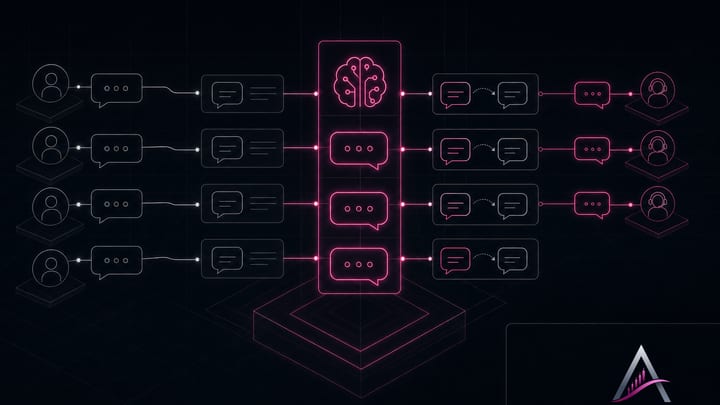
The mechanism is simpler than it sounds. Each message is a short piece of text. When a message comes in, the tool detects the language, sends the text to a translation model, and shows the operator the translated version alongside or instead of the original. When the operator types a reply, the same thing happens in reverse before the customer sees it.
Three details matter in practice.
- Detection happens per message, not per conversation. A customer who switches from French to English halfway through should be followed, not locked into the first language.
- The customer should see the original text of their own messages, not a round trip through two translations.
- The operator should be able to see the original too. When a translation looks odd, the original often clears it up.
Where translation falls short
Machine translation is good at plain sentences and poor at the things that make a brand feel human. Expect trouble with:
- Product names and feature names. A model may translate "Desk" into a piece of furniture.
- Idioms and jokes. They either vanish or come out strange.
- Register. French has tu and vous. Spanish has tú and usted. A model may pick the wrong one, and the wrong one reads as rude or stiff.
- Short replies. "Sure" or "On it" give the model almost nothing to work with, and the result can be unclear.
The fix is not to avoid translation. It is to write replies that translate well: full sentences, one idea each, no slang, and product names spelled the way you want them to appear. The habit helps your English customers too.
Quebec in particular
If you have customers in Quebec, make French the default in the chat window for visitors on your French pages, not an option they have to find. Greet in French. Keep your French help content as complete as your English content, because any AI or any person will only be as good as the material behind them. And if a conversation needs a human who speaks French, say so plainly and give a real time rather than a vague promise.
Being served in French in Quebec is not a courtesy. It is what customers are owed.
Where ATON Desk fits
ATON Desk is live chat for websites from Atheron Network Labs. It is coming soon and is not open to customers yet. An AI agent trained on your website, your files and your past answers replies first, says it is an AI, and offers a person after its first answer. An operator takes over in one click with a short summary, and unanswered questions become draft articles for you to approve.
We are not going to describe language features here that you cannot try yet. When ATON Desk opens, we will state plainly what it does for French and other languages, and what it does not. Until then, the questions in this guide are the ones to ask of any chat tool: does it detect language per message, does it show originals, and does it let a person step in when the translation is not good enough.
If you want to know when it opens, you can join the waitlist. Every plan will include AI conversations, there will be a free plan and a trial with no card, and our own support will run on it.